
Mae Russell is a Ballads and Song Research Volunteer, taking part in the Strange Doings in London project run by Bloomsbury Festival and supported by the National Lottery Heritage Fund.
Paper, People, Place: A Visit to Camden Archives by Mae Russell
Tucked quietly above the hum of the Holborn Library sits the Camden Local Studies and Archives Centre – a space that holds centuries, not just of paper and ink, but of people. Here is where our third session with the Strange Doings in London heritage project took place. A visit that felt different from the previous – more grounded. We were looking at the records of the area, in the area – and that proximity made everything feel more immediate, more real.
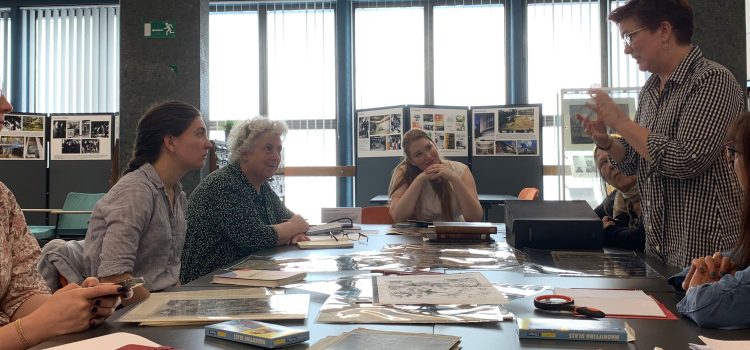
We were welcomed by Senior Archivist Tudor Allen, whose care and enthusiasm for the material shaped the day. He and his team had prepared an array of documents, books, prints, and ballads specifically for our project, drawing a line through time from the parish of St Giles to the pages in front of us. This was local history in the most literal sense – not abstract or broadly academic, but tangible, handwritten, sometimes clumsily spelled, always grounded in real lives. The library space below was buzzing gently with people reading, studying, printing forms, and only a few floors above, here were the stories of their neighbourhood, their family history, their city’s deep layers.
Tudor told us plainly: many records once dismissed as unimportant or too commonplace have since been lost.
And shared they were. Tudor guided us through what his team had assembled: a diary kept by the keeper of Hampstead Heath in the 1830s, filled with bad spelling, coarse humour, and wonderfully human complaint; a record from Karl Marx’s burial in Highgate Cemetery; letters written by Charles Dickens himself – bringing our very first research session full circle. He showed us a 17th-century document recording a grant of land in the parish of St Giles from King James I, complete with his official wax seal. Many of the materials were legal or administrative – minutes from vestries, valuations, and council reports – but Tudor was quick to remind us that these ‘dry’ documents are often anything but. When read closely, they come alive with detail, context, and sometimes even drama. Among the most moving moments of the visit was the chance to examine a selection of historical ballads – preserved in a small box, their pages so thin they felt like air. Vivien Ellis, ever our musical compass in this work, even sang one aloud. One moment stood out: Vivien spotted a ballad titled Bushes and Briars and recognised it immediately. It was one she had known for years, from near where she lives – and yet here it was, catalogued as having originated in St Giles. A song once from St Giles, now part of her own landscape. It was a beautiful, almost uncanny reminder of how songs travel. How they stretch across boroughs, generations, and class lines. These were once St Giles ballads – and now they belong to far more.
The archive also included a handful of illustrations and documents related to the Rookery – a former slum in St Giles, often cited for its overcrowding and poverty. While the images were few, their inclusion helped further root the area’s complex past into something visual and place-based.
And that’s what this project keeps returning to – layers. You begin to feel that the streets of London are covered in these threads, crisscrossing silently beneath the surface. We walk over them daily without knowing. Research like this helps you start to feel their tug.
The Camden Archives isn’t just a repository. It’s a bridge. A web. A classroom. A memory palace. And on this day, it became a shared space of exploration, curiosity, and deep respect for the past. That feels like something worth preserving too.